
WebP vs AVIF Format Comparison - Which Is Better?

WebP revolutionized web images, but AVIF is the new competitor. This comprehensive comparison helps you understand both formats and decide when to use each one.
WebP vs AVIF: Quick Overview
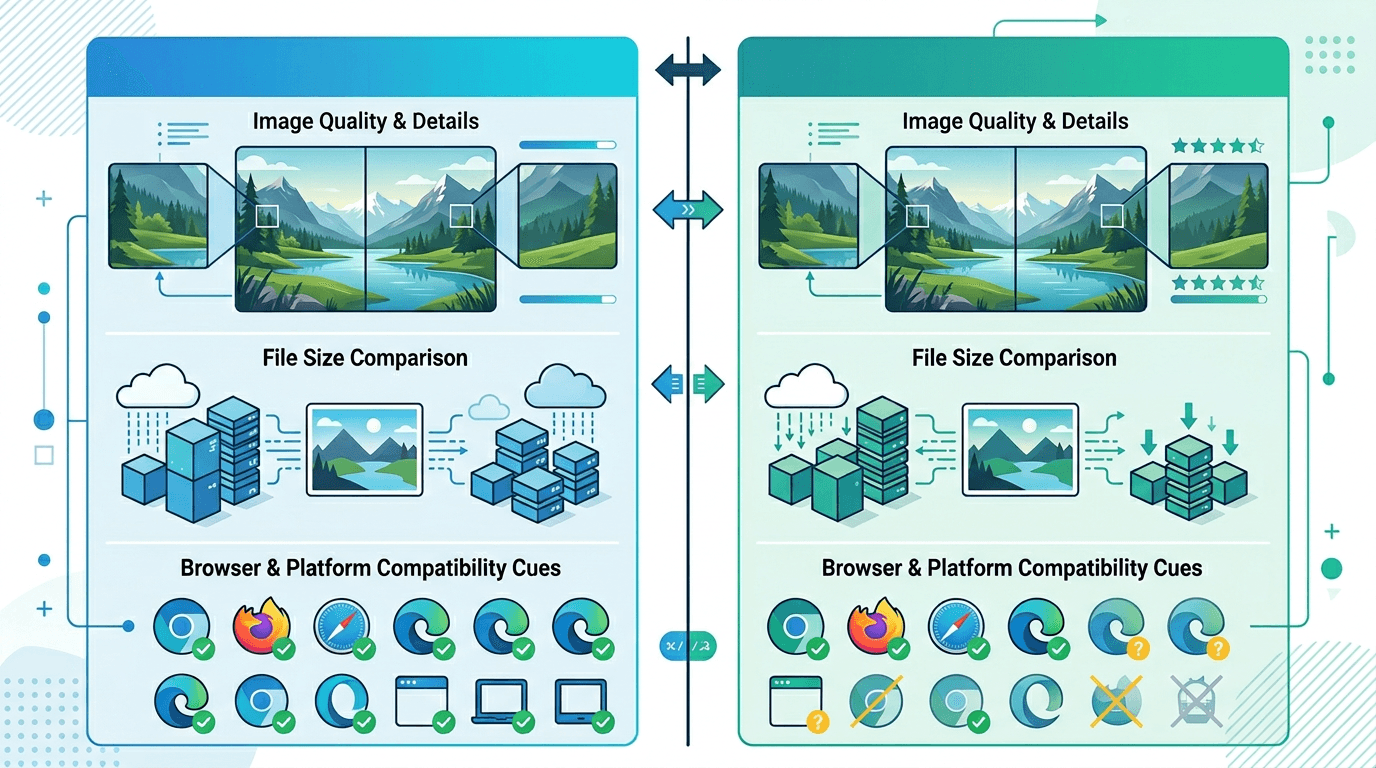
| Feature | WebP | AVIF |
|---|---|---|
| Release year | 2010 | 2019 |
| Developer | Alliance for Open Media | |
| Compression | VP8/VP9 | AV1 |
| File size | 25–35% smaller than JPG | 50% smaller than JPG |
| Quality | Very good | Excellent |
| Browser support | 97%+ | 93%+ |
| Encoding speed | Fast | Slow |
Compression Comparison
File Size at Equal Quality
Real-world test results:
| Image Type | JPG Size | WebP Size | AVIF Size |
|---|---|---|---|
| Photo | 1 MB | 650 KB | 500 KB |
| Graphic | 500 KB | 350 KB | 250 KB |
| Screenshot | 800 KB | 480 KB | 320 KB |
AVIF advantage: 20–25% smaller than WebP.
Quality at Equal File Size
| Metric | WebP | AVIF |
|---|---|---|
| Visual quality | Very good | Excellent |
| Fine detail | Good | Better |
| Color accuracy | Good | Very good |
| Gradient handling | Good | Excellent |
Feature Comparison
Transparency
Both formats support alpha channel:
- Full 8-bit transparency
- Semi-transparent pixels
- Anti-aliased edges
Result: Tie
Animation
Both support animation:
- WebP: Good animation support
- AVIF: Better animation compression
Result: AVIF wins slightly
HDR Support
| Feature | WebP | AVIF |
|---|---|---|
| 10-bit color | Limited | Full |
| HDR formats | No | Yes (PQ, HLG) |
| Wide color gamut | Limited | Full |
Result: AVIF clearly better
Lossy and Lossless
Both formats support:
- Lossy compression
- Lossless compression
Result: Tie
Browser Support
WebP Support
| Browser | Since |
|---|---|
| Chrome | 2014 |
| Firefox | 2019 |
| Safari | 2020 |
| Edge | 2018 |
Global coverage: ~97%
AVIF Support
| Browser | Since |
|---|---|
| Chrome | 2020 |
| Firefox | 2021 |
| Safari | 2022 |
| Edge | 2024 |
Global coverage: ~93%
Performance Comparison
Encoding Speed
| Format | Relative Speed |
|---|---|
| JPG | 1× (baseline) |
| WebP | 1.5× slower |
| AVIF | 10× slower |
AVIF encoding is significantly slower, but decoding speed is comparable.
Decoding Speed
| Format | Decoding Speed |
|---|---|
| JPG | Very fast |
| WebP | Fast |
| AVIF | Fast |
Decoding speed is similar when viewing.
CPU Usage
| Operation | WebP | AVIF |
|---|---|---|
| Encoding | Medium | High |
| Decoding | Low | Low–Medium |
When to Use WebP
WebP is better when:
-
Maximum compatibility is needed
- Older browser support
- Email compatibility
- Legacy systems
-
Fast encoding is required
- Real-time processing
- Large-volume conversion
- Server-side generation
-
Animation is the primary use
- Animated stickers
- Simple animations
- GIF replacement
When to Use AVIF
AVIF is better when:
-
Maximum compression is needed
- Bandwidth-critical sites
- Mobile-first design
- Storage optimization
-
Quality is the priority
- Photography sites
- E-commerce products
- Professional portfolios
-
Modern features are required
- HDR content
- Wide color gamut
- 10/12-bit depth
Converting WebP to AVIF
Using Our Converter
- Visit the WebP to AVIF converter
- Upload your WebP file
- Select quality settings
- Download the AVIF version
Quality Mapping
| WebP Quality | Equivalent AVIF |
|---|---|
| 90% | 80% |
| 80% | 70% |
| 70% | 60% |
Implementation Strategies
Progressive Enhancement
Serve the best format for each browser:
<picture>
  <source srcset="image.avif" type="image/avif">
  <source srcset="image.webp" type="image/webp">
  <img src="image.jpg" alt="Description">
</picture>
Content Negotiation
Server-side format selection based on the Accept header.
Build-Time Generation
Generate all formats during the build process.
Migration Considerations
From WebP to AVIF
Reasons to migrate:
- Extra 20–25% savings
- Better quality
- Future-proof format
Considerations:
- Slower encoding
- Slightly lower support
- Needs WebP / JPG fallback
Keeping Both Formats
Maximum compatibility strategy:
- AVIF for modern browsers
- WebP for wider support
- JPG as the final fallback
Real-World Results
E-Commerce Site
| Metric | WebP | AVIF | Improvement |
|---|---|---|---|
| Total size | 2.5 MB | 1.9 MB | 24% |
| Load time | 2.1s | 1.7s | 19% |
| LCP | 1.8s | 1.5s | 17% |
Photography Blog
| Metric | WebP | AVIF | Improvement |
|---|---|---|---|
| Image quality | Good | Excellent | Noticeable |
| File size | 4 MB | 3 MB | 25% |
| Page weight | 6 MB | 4.8 MB | 20% |
Future Outlook
WebP
- Mature, stable format
- Will remain important
- Gradually being displaced by AVIF
- Still essential for compatibility
AVIF
- Rapidly growing
- Becoming the preferred format
- Hardware acceleration improving
- Strong industry support
Frequently Asked Questions
Is AVIF better than WebP?
In terms of file size and quality, yes. AVIF achieves 20–25% smaller files and better visual quality. However, WebP has wider support.
Should I convert all my WebP to AVIF?
For new projects, consider AVIF with WebP fallback. For existing sites, migrate incrementally while keeping WebP.
Does AVIF replace WebP?
Not yet. WebP is still necessary for compatibility. Use both with appropriate fallbacks.
Which has better animation support?
Both support animation. AVIF offers better compression; WebP has wider tool support.
Is the quality difference noticeable?
Under aggressive compression, AVIF maintains quality better. At high quality settings, the difference is minimal.
How do I implement AVIF on my website?
Use the <picture> element with AVIF as the first source, WebP as the second, and JPG as the fallback. Most modern frameworks also support automatic format selection.
Does AVIF support transparency?
Yes. AVIF supports full alpha channel transparency, just like WebP and PNG.
What tools can generate AVIF files?
You can use our WebP to AVIF converter, or tools like ImageMagick, libavif, Squoosh, and Sharp (Node.js).
Conclusion
AVIF offers better compression and quality than WebP, making it ideal for performance-conscious websites. However, WebP's wider support makes it necessary as a fallback. Use our WebP to AVIF converter to upgrade your images while maintaining compatibility.
Related tools: AVIF to WebP | JPG to AVIF | Image Compressor