
JPG vs AVIF Format Comparison - Complete Guide
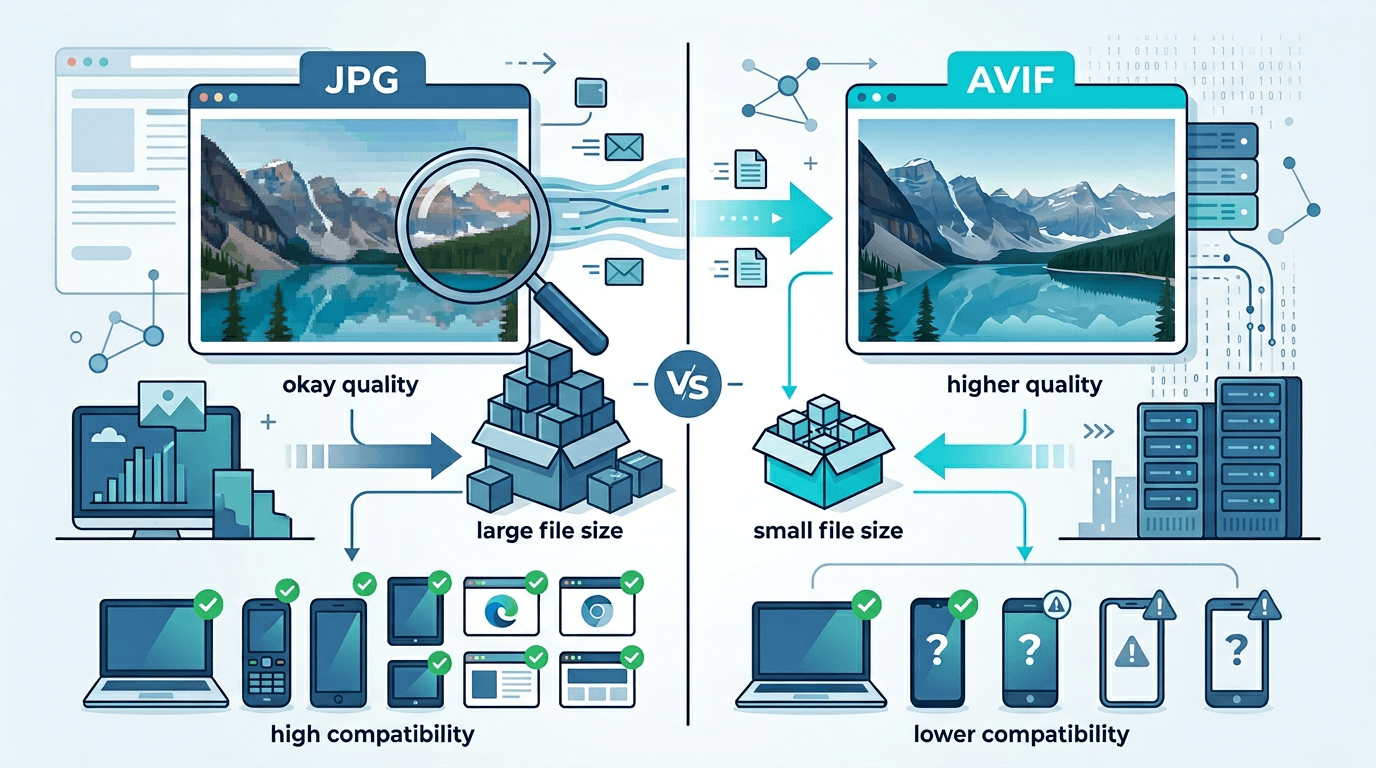
JPG has been the standard for photographs since the 1990s, but AVIF is emerging as its modern successor. This comprehensive comparison helps you understand the differences and decide when to use each format.
JPG vs AVIF: Overview
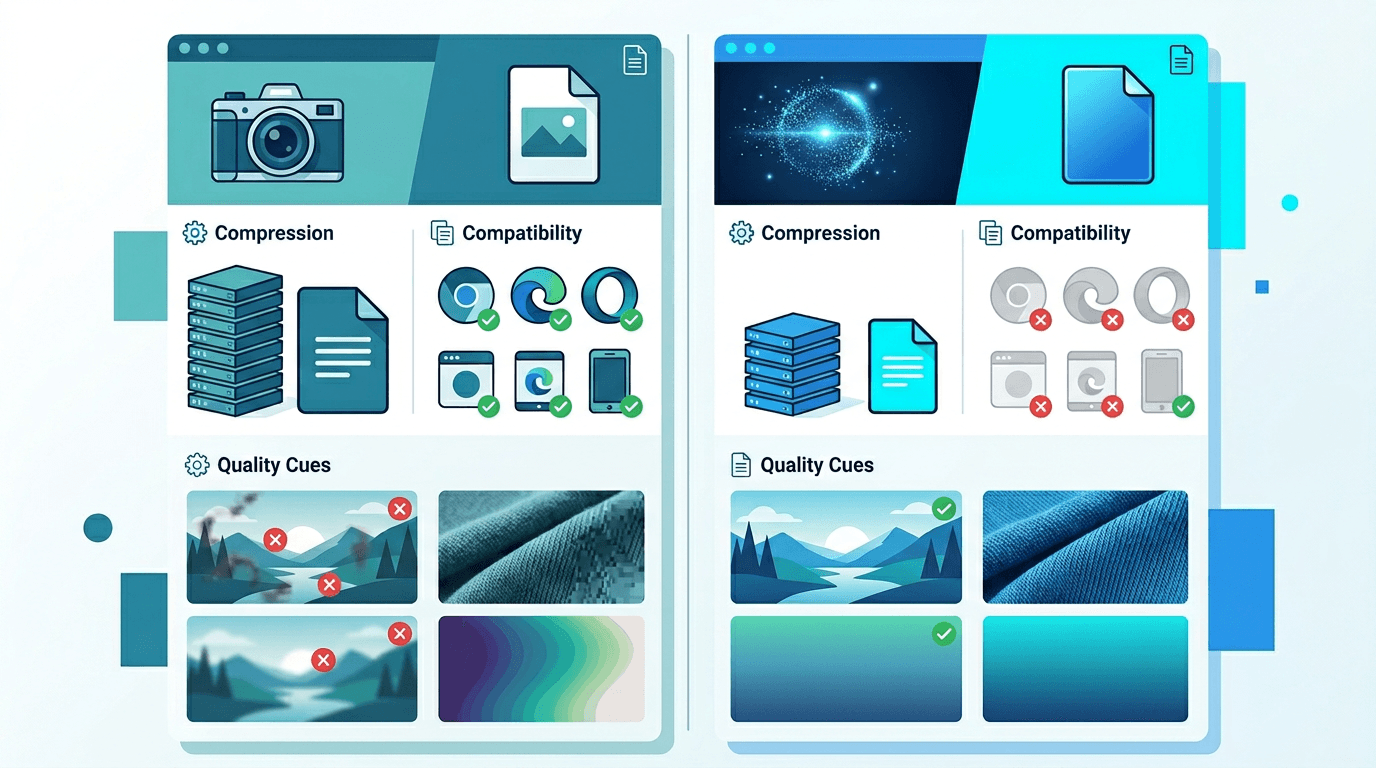
| Feature | JPG | AVIF |
|---|---|---|
| Release Year | 1992 | 2019 |
| Compression | Lossy (DCT) | Lossy/Lossless (AV1) |
| File Size | Baseline | 50% smaller |
| Quality | Good | Excellent |
| Browser Support | 100% | 93%+ |
| Transparency | No | Yes |
| Animation | No | Yes |
| HDR | No | Yes |
Compression Technology
JPG Compression
JPG uses Discrete Cosine Transform (DCT):
- Divides image into 8×8 blocks
- Transforms to frequency domain
- Quantizes high frequencies
- Good but dated technology
AVIF Compression
AVIF uses AV1 video codec:
- Larger block sizes (up to 128×128)
- Advanced intra-frame prediction
- Better entropy coding
- Film grain synthesis
- State-of-the-art compression
File Size Comparison
Real-world testing at equivalent visual quality:
| Image Type | JPG Size | AVIF Size | Savings |
|---|---|---|---|
| Portrait | 1.2 MB | 520 KB | 57% |
| Landscape | 1.8 MB | 750 KB | 58% |
| Product | 850 KB | 350 KB | 59% |
| Screenshot | 620 KB | 240 KB | 61% |
Average: AVIF is 50-60% smaller at equivalent quality.
Quality Comparison
At High Quality Settings
| Metric | JPG 95% | AVIF 85% |
|---|---|---|
| File size | 2.5 MB | 1.1 MB |
| Visual quality | Excellent | Excellent |
| SSIM score | 0.97 | 0.97 |
| Fine detail | Preserved | Preserved |
At Medium Quality
| Metric | JPG 80% | AVIF 70% |
|---|---|---|
| File size | 750 KB | 320 KB |
| Visual quality | Very good | Very good |
| SSIM score | 0.92 | 0.93 |
| Fine detail | Some loss | Better preserved |
At Lower Quality
| Metric | JPG 60% | AVIF 50% |
|---|---|---|
| File size | 350 KB | 140 KB |
| Visual quality | Acceptable | Good |
| SSIM score | 0.84 | 0.89 |
| Artifacts | Heavy blocking | Smoother blur |
Feature Comparison
Transparency Support
| Format | Transparency |
|---|---|
| JPG | Not supported |
| AVIF | Full alpha channel |
Winner: AVIF for any images requiring transparency.
Animation Support
| Format | Animation |
|---|---|
| JPG | Not supported |
| AVIF | Full support |
Winner: AVIF can replace animated GIFs with much smaller files.
Color Depth
| Format | Color Depth |
|---|---|
| JPG | 8-bit (16.7M colors) |
| AVIF | 8/10/12-bit |
Winner: AVIF for professional and HDR content.
HDR Support
| Format | HDR |
|---|---|
| JPG | Not supported |
| AVIF | PQ, HLG supported |
Winner: AVIF is the only choice for HDR images.
Browser Support
JPG Support
- All browsers: 100%
- All devices: Universal
- All applications: Universal
AVIF Support
| Browser | Version |
|---|---|
| Chrome | 85+ (2020) |
| Firefox | 93+ (2021) |
| Safari | 16+ (2022) |
| Edge | 121+ (2024) |
Global coverage: ~93%
Use Cases
When JPG is Better
-
Universal compatibility required
- Email attachments
- Legacy systems
- Older software
-
Quick processing needed
- Real-time encoding
- High-volume batch work
- Server-side generation
-
Simplicity preferred
- No fallback needed
- Maximum compatibility
When AVIF is Better
-
Web performance priority
- Public websites
- Mobile apps
- E-commerce sites
-
Quality matters
- Photography portfolios
- Product catalogs
- Professional galleries
-
Modern features needed
- Transparency
- HDR content
- Animation
Converting JPG to AVIF
Using Our Converter
- Visit JPG to AVIF converter
- Upload JPG files
- Select quality (75-85% recommended)
- Download AVIF versions
Quality Mapping
| JPG Quality | Equivalent AVIF |
|---|---|
| 95% | 85% |
| 85% | 75% |
| 75% | 65% |
| 65% | 55% |
Implementation Strategy
For Websites
Use picture element with fallback:
<picture>
  <source srcset="photo.avif" type="image/avif">
  <img src="photo.jpg" alt="Description">
</picture>
For Applications
Check support and serve appropriate format:
- Modern browsers: AVIF
- Older browsers: JPG fallback
Encoding and Decoding Speed
| Operation | JPG | AVIF |
|---|---|---|
| Encoding | Fast | Slow (5-10x) |
| Decoding | Very fast | Fast |
| CPU usage | Low | Moderate |
Note: AVIF encoding is slower but decode speed is comparable.
Future Outlook
JPG
- Mature, stable format
- Will remain for compatibility
- Gradually declining for web use
- Still essential for email/legacy
AVIF
- Growing browser support
- Becoming web standard
- Hardware acceleration coming
- Industry backing from Google, Apple, Netflix
Frequently Asked Questions
Is AVIF better than JPG?
For file size and quality, yes. AVIF achieves 50% smaller files at equivalent quality. However, JPG has universal compatibility.
Should I convert all JPG to AVIF?
For web use, yes with JPG fallback. For email and legacy applications, keep JPG.
Does AVIF replace JPG completely?
Not yet. JPG remains necessary for universal compatibility. Use both formats with appropriate fallbacks.
Is AVIF quality as good as JPG?
AVIF quality is equal or better than JPG at the same file size, with fewer visible artifacts.
Will JPG become obsolete?
Not in the near future. JPG will remain important for compatibility, but web use will shift to AVIF/WebP.
Conclusion
AVIF offers significant advantages over JPG: 50% smaller files, better quality at equal size, plus features like transparency and HDR. For web publishing, converting JPG to AVIF provides clear benefits. However, JPG remains essential for maximum compatibility.
Related tools: JPG to WebP | Image Compressor | AVIF to JPG